How Kyoto artisans keep their traditions alive with Instagram and Airbnb
Advertisement
People
How Kyoto artisans keep their traditions alive with Instagram and Airbnb
On a recent visit to Kyoto, CNA Luxury ventured to iii workshops specialising in traditional Japanese crafts to find out how these centuries-old businesses maintain relevance in the modern era.
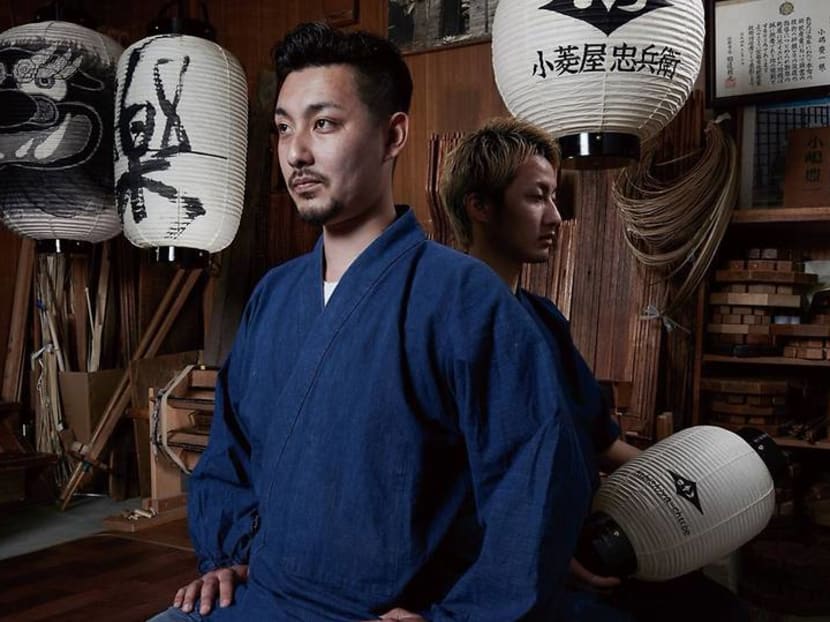
Brothers Syun (foreground), 34, and Ryo Kojima, 31 in Kojima Shouten's dwelling house atelier. (Photo: Kojima Shoten)
02 Jan 2022 06:30AM (Updated: 21 May 2022 02:37PM)
In Kojima Shouten'south domicile atelier, brothers Syun, 34, and Ryo Kojima, 31, and their father Mamoru, 59, are deftly working on lanterns measuring 1m in height and 42cm in diameter using the traditional technique of jibari-shiki, carrying on a family business that has existed since 1800.
This manufacturing technique involves creating a lantern frame past bending thinly cutting bamboo strips into screw rings, which are then fixed together with hemp strings. Its laborious nature makes it a rarity these days – near lantern-makers go for the quicker makibone-shiki method that winds one long thin bamboo strip into a screw frame – but it produces hardy chochin lanterns with striking structures.

During a recent visit, we observed how Syun cut and bent the bamboo strips, Ryo tied the hemp strings, and their father pasted washi paper onto the frames earlier painting the design. It would take them three to four days to finish one.
"We don't feel we have to continue this piece of work, we simply beloved it," said Syun, speaking through their marketing coordinator Shinya Takeda, a childhood friend who was roped into business organisation. "We grew upward watching our male parent and grandfather at work and we desire to continue this cute art."
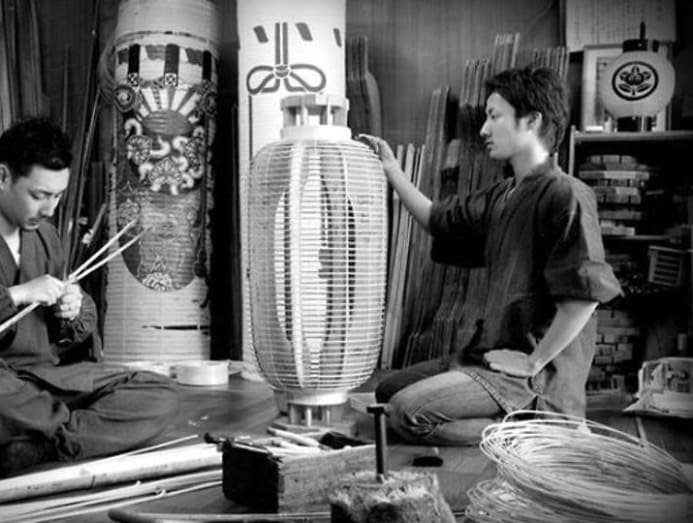
Previously, chochin lanterns were mainly used in temples and restaurants as signages. Thank you to the Kojima brothers' efforts in creating unusual, contemporary designs, they are now gaining popularity overseas in countries such equally France and the US as interior decor objects in luxury homes, light installations in retail shops and fifty-fifty as pavilions huge enough for people to sit down in. They are now launching a collection of way tees and soon, customised jeans.
On their Instagram page @kojima_shouten, backside-the-scenes and updates of their latest projects and products are regularly posted. That strategy has paid off: Kojima Shoten's orders come almost exclusively via the social media channel and past word-of-mouth, Merely the family places a premium over quality. Ryo said: "We want to enjoy the creative procedure. Later every lantern, we always want to say 'this is perfect'."

READ> Onsens and kaiseki: 5 new hotels in Japan to check-in to on your adjacent vacation
COMPETITIONS AND COLLABORATIONS
Kojima Shoten's success story illustrates the demand for traditional arts to constantly invent itself while keeping to its core values to stay live. Another case in point: Takezasado, a family studio that has specialised in traditional Japanese woodblock printing since 1891.
Woodblock press is one of the oldest printmaking forms in the world. It involves applying ink or pigment on a piece of carved cake, placing a sheet of Japanese paper on the cake, and and then rubbing the paper with a disk covered with bamboo.

Sometimes multiple blocks are used or dissimilar colours are used on different sections of the same block. So the sketch designer, the carver who sculpts the cake, and the printer applying the color layers need to exist adept specialists with a sharp eye for details – the very reasons why Japanese woodblock prints are highly appreciated around the globe.
Its 5th generation master Kenji Takenaka, 49, has made assuming moves in design and educational collaborations to give the arts and crafts a modern appeal. Besides original woodblock prints, Takezasado besides stocks a range of items such as kitchen towels, silkscreen handkerchiefs, and volume covers with kawaii prints at its store to tug at your purse strings.
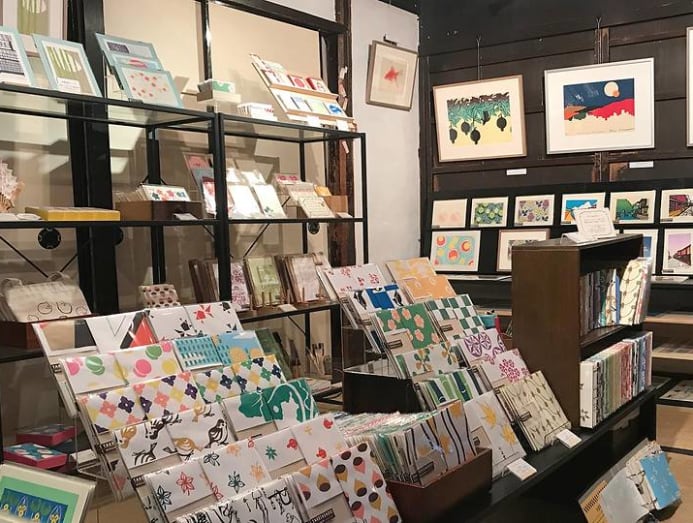
In 2013, Takenaka partnered art managing director Yoshiki Uchida to create a print that won the Bronze Pencil Award at The One Prove 2013, 1 of the well-nigh prestigious international competitions in the creative industry. It was the starting time fourth dimension that a piece of work employing traditional craftsmanship had clinched a prize. In September 2019, Takezasado'south record jacket "Rare Groove UY" design won the silverish prize at the Pentawards 2019, an annual laurels that recognises the best in packet blueprint worldwide.
Takenaka told CNA Luxury: "Traditional artists don't unremarkably join these kind of competitions. But I desire to show that woodblock press can be attractive in many ways. Many companies have seen what we've done and take asked us to make things for them."
While he acknowledges that profits are not huge ("sometimes we are busy, sometimes business is low"), it is undeniable that his collaborations with educational institutions, museums, and even popular anime television series, have fabricated the fine art of traditional woodblock printing more widely appreciated.

There is also a youthful vibe in the Takezasado atelier. Besides Takenaka'southward father, Seihachi Takenaka, 89, the other artisans who exercise the carving and printing are in their 20s and 30s. And in a difference from tradition, Takenaka appointed a female person woodblock artist and production designer who is non a family member, Yuko Harada, 38, as the sixth generation successor, believing that her talent in contemporary design will hold the business in adept stead.
READ> Temples, ryokans and tombstones: A ho-hum travel guide to Kyoto, Nihon
A SLOW RIDE
Just while some seem to be making strides, it's been a slow ride for others such every bit Tatsumura Koho, which is well known for nishiki weaving since 1876.
Introduced from China over i,200 years ago, nishiki weaving uses silk threads that take a prismatic structure to create a fabric that has a iii-dimensional outcome and a sparkling luminosity.
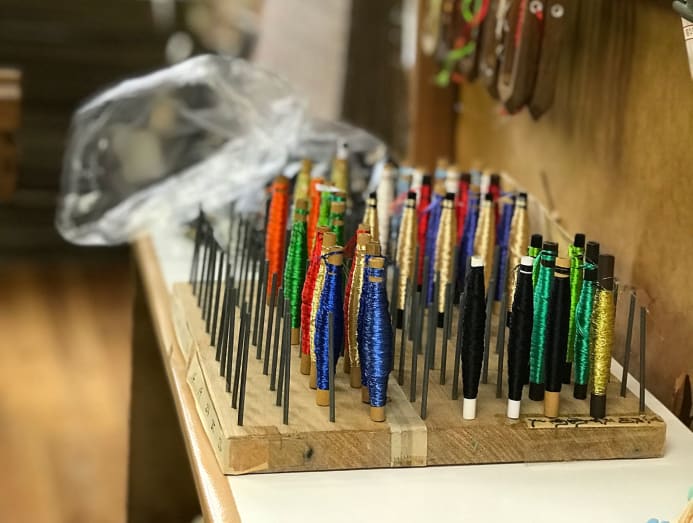
From looms re-created from the original ones used in People's republic of china to the jacquard punch cards that guide the weaving and whose pixel-similar specks are punched out one at a time, and the rare Miyazaki red oak loom shuttles made by just one man in Japan, the process is all about rare skilled craftsmanship.
Founder Heizo Tatsumura and his son were instrumental in restoring ancient textiles, including works designated as national treasures, and creating new tapestries for the Showa Imperial Palace. They also established the Japan Traditional Weaving Preservation Research Social club to study the techniques and pass them to a younger generation.
Current art managing director Koho Tatsumura is the tertiary generation, and has been credited for introducing contemporary designs that accept been made into state gifts for foreign dignitaries as well as everyday accessories such as kimono, obi, pouches and clutches.
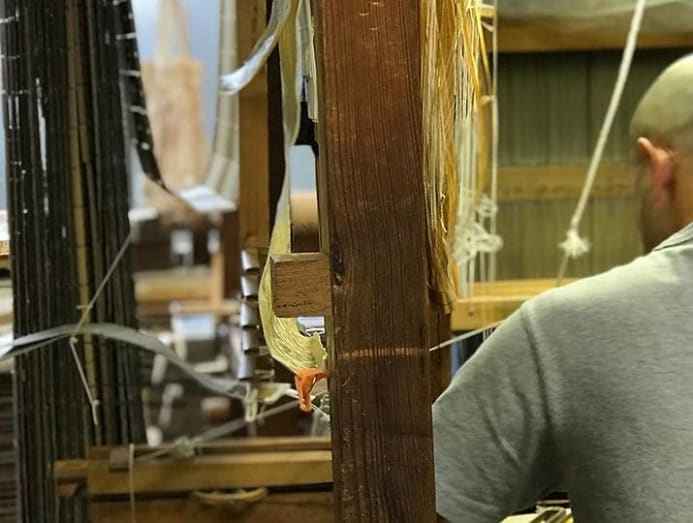
The Tatsumura Koho studio is open for visits and weaving workshops (information technology's a popular Airbnb Experience and the just one of its kind in Kyoto). However, it currently only has two weavers working in the atelier as information technology typically takes ten years to acquire nishiki weaving, said Amane Tatsumura (@kyoto_traditional_textile), 45, the fourth generation successor.
While his begetter has developed a curriculum that shortens the learning curve to two years – Amane himself learned the skills inside a yr only because he used to exist a stone drummer, which gave him a huge reward in manus-leg coordination – finding immature people committed enough to take information technology up has proven to be challenging.
Nevertheless, Amane is adamant to continue breaking new ground with the craft and has been working with students at the local Doshisha University on creative ways to use the fabric, such every bit a spoon fashioned out of aureate nishiki-woven fabric. "The number of families doing this arts and crafts is becoming fewer. I joined the business organisation equally I feel it is worth continuing this fine art form, which represents Japanese culture in many ways."
WATCH> He is one of only xx craftsmen in Japan keeping a 329-year-erstwhile tradition alive

Recent Searches
Trending Topics
mcfarlandwithashad.blogspot.com
Source: https://cnalifestyle.channelnewsasia.com/people/how-kyoto-artisans-keep-their-traditional-crafts-alive-177061
0 Response to "How Kyoto artisans keep their traditions alive with Instagram and Airbnb"
Post a Comment